What I Learned About Presence, Healthcare, and Advocacy in My Gram’s Final Weeks
I logged into LinkedIn today and was met with all the usual end-of-year posts: resets, reflections, bold intentions for 2026. (👏🏼)
I haven’t been here on LinkedIn much lately. December was busy…but not in the way we usually mean when we say that. It was busy with family, with grief, and with being present for someone who mattered deeply to me: my grandma, Gladys.
Writing is cathartic for me, and as I sat at my desk today doing some New Year housekeeping, it felt unsettling to only look ahead without acknowledging what this past month held.
Earlier this week, my husband, Greg, and I were at his pre-knee-surgery appointment. The nurse practitioner asked how our Christmas was. Greg and I exchanged that familiar, awkward chuckle. You know the one... it comes when the honest answer is a little bit complicated. I shared that it had been an unusual year; I mentioned a sick family member… and then quietly said, “my gram passed away.” Saying it out loud for the first time caught me off guard.
Seeing Healthcare Through a Family Lens
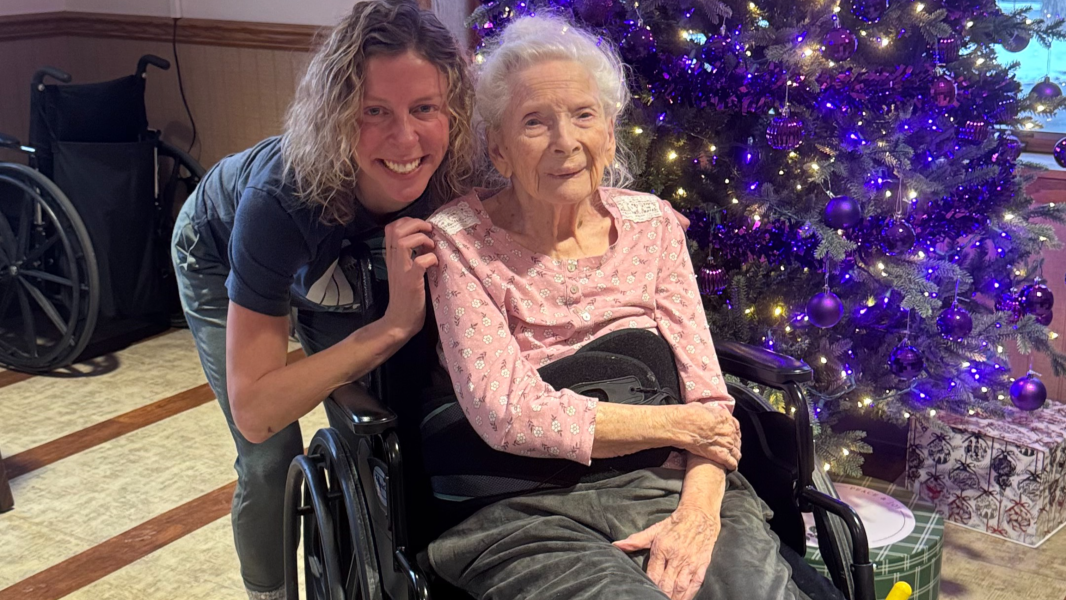
My gram spent her final weeks in a nursing home and hospice setting in a very small town in rural Pennsylvania. Being that close to the system (not as a professional, but as family) was eye-opening in a way that no conference panel, white paper, or strategy deck can replicate.
The People
First, the people... because for me, it’s always about the people. The nurses, aides, and staff working in nursing homes are healthcare heroes. Full stop. The level of empathy, patience, and emotional labor required to care for residents and patients, especially those with dementia AND in hospice, is extraordinary. And they don’t just support patients; they support families too, often in moments of exhaustion, uncertainty, and emotion. These are true caregivers, doing deep human work under incredibly hard conditions. 🫶🏼
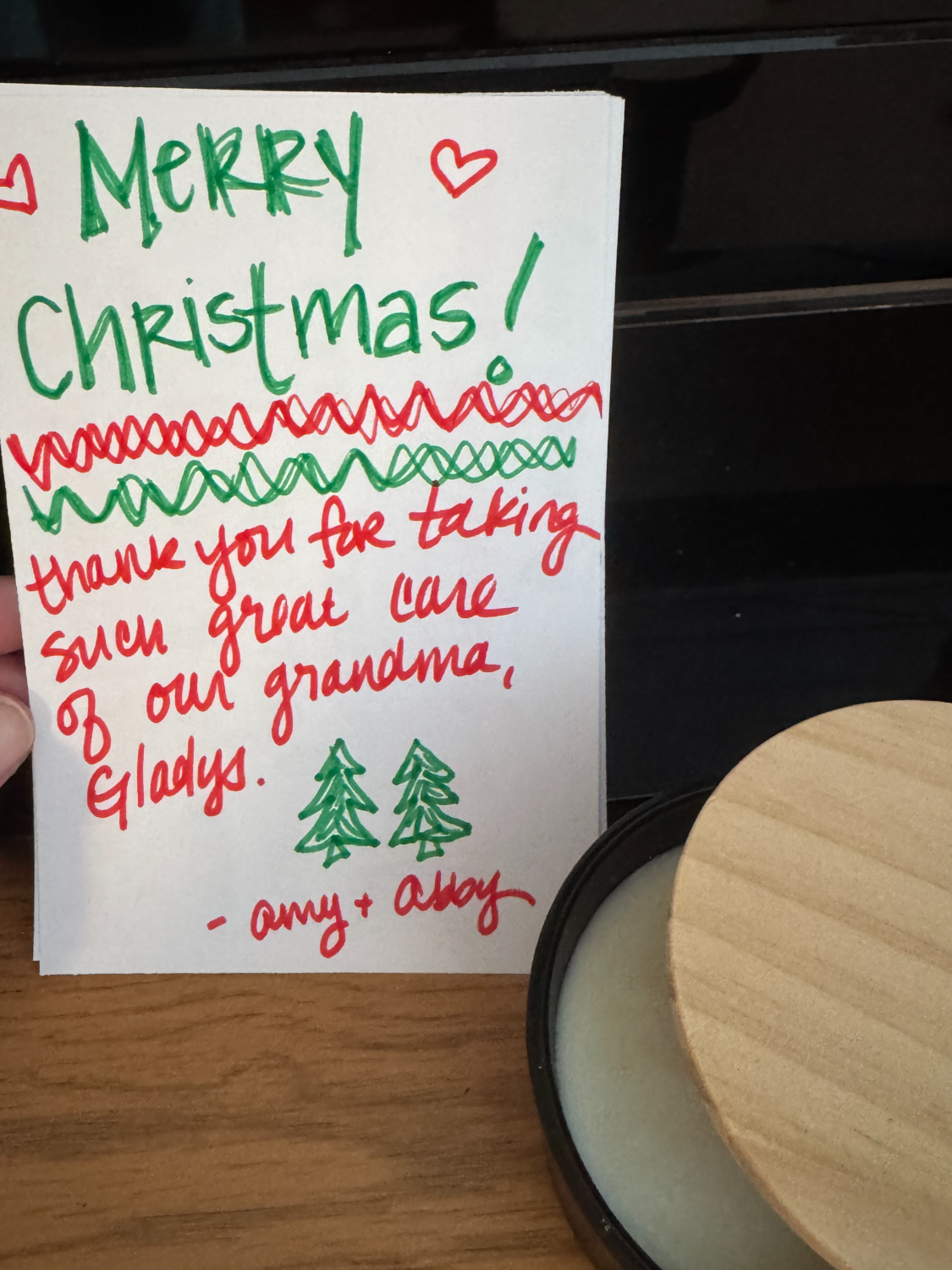
Abby made mini sourdough loaves and I made candles to give out to the nursing home staff.
24/7 Care
I spent multiple overnights by my gram's side on a recliner, and it didn’t take long to understand just how demanding this care really is. On night one, it was clear she needed round-the-clock care to prevent falls. With dementia, she would wake up in the middle of the night and VERY instinctively try to do “routine tasks," like switching the laundry, turning off kitchen lights, or checking on “the kids upstairs." These responsibilities were top of mind, even though they were from decades earlier.
That level of constant vigilance and the overnight nursing home experience is something I couldn’t fully understand until I was there in it. I am so fortunate to have a home and work life that allowed me to show up and help where I could. And, I'm very grateful for an incredible caregiver (turned-family member), aunt, and father who carried the the work (a lot of it) when I wasn't there.
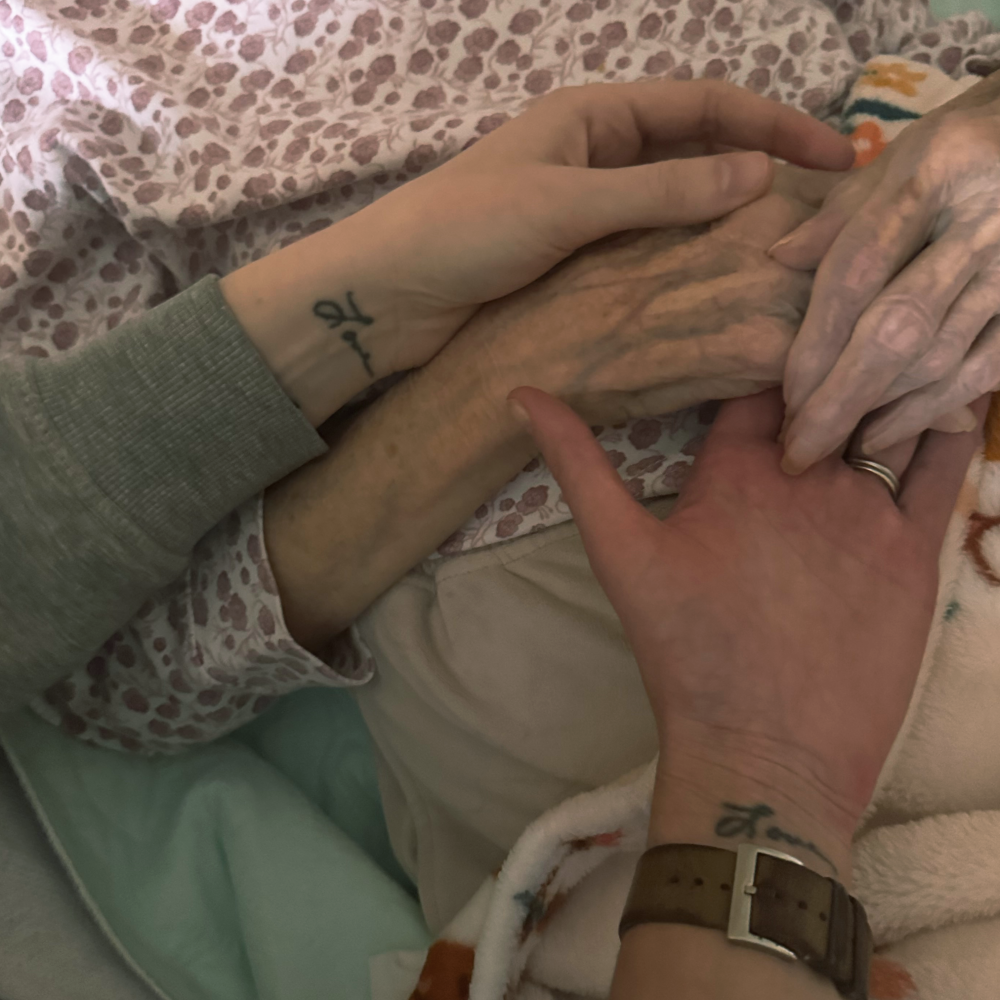
Ab and I got "Love" tattoos from our Gram's handwriting a decade ago. As we expected when we got them, Gram was NOT impressed!! But in more recent, dementia-full years, she at times thought it was sweet. <3
The System
We also learned how quickly logistics and coverage can change once hospice enters the picture. Because my gram was no longer doing physical therapy, Medicare stopped covering her nursing home stay. Even transportation, like getting her back home for hospice (which ultimately wasn’t decided), would have been out of pocket. Thankfully, my gram still had her community ambulance membership to cover any potential rides. (Small town America, #amiright? 🚑)
But it was impossible not to think, what if she didn’t? What if she didn’t have family nearby to navigate this? Or family to pay for an amazing caregiver? What if no one knew which questions to ask, or even that they should be asking them?
Questions I’m Still Sitting With
During all of this, I of course thought of many healthcare questions, like:
How does the system support this level of care without significant family involvement?
What happens when families don’t have flexibility, proximity, or the ability to show up daily, whether themselves or through a paid caregiver?
If this work is essential (and it is), why does compensation so rarely reflect its complexity, responsibility, and emotional toll?
How are care models designed to acknowledge both clinical needs AND human behavior…. especially as our population continues to age?
We all know the stats: the U.S. population is aging rapidly, and care beyond the walls of the hospital will only continue to increase. Health systems and technology companies are being asked (alt verbs: begged, forrced) to meet patients where they are, while navigating workforce shortages and rising demand. Seeing this up close gave those conversations entirely new weight for me. (I still think about the “Dark Side of the Moon” session at ViVE with Rasu Shrestha MD MBA and Deborah DiSanzo.)
Layered on top of that were realities so many of us know in theory, but feel differently when they're personal: staffing shortages, turnover, clinicians driving in from neighboring towns and states to cover medication administration, confusion across staff shift changes, conflicting information, physicians covering multiple facilities and only onsite periodically. There is SO much to unpack, and it’s why I’m especially excited to dive into The Borderless Healthcare Revolution by Sarah Matt MD, MBA for January's Bluebird Leaders book club. Perfect timing.
This experience has also made me think more deeply about patient advocacy. Not just as a role, but as a responsibility. Being present, asking questions, connecting dots, and helping navigate a complex system shouldn’t depend on luck or availability or privilege.
Gladys, Still Gladys
What makes this harder is that, before her final fall, my gram was doing remarkably well. When I first visited her after her initial fall in mid-November, she was bedridden and struggling. But over just a couple of weeks, she rallied, because that's just who my gram was. She thrived in PT, went to the dining room for meals, and overall was settling in. (The staff all LOVED her.) 👩🏼⚕️
When she fell again and suffered a brain bleed, everything changed. It’s impossible not to think about the “what ifs.” She was 95, but if resilience were the metric, she had plenty left.
Even after that, she still had moments of Gladys...clear, unmistakable flashes of my gram. She would insist on getting into her wheelchair, become suddenly alert in the midst of so much confusion, compliment me while knowing I was her oldest grandkid, or crack a quick-witted comment that reminded us exactly who she was. I am so grateful I was able to spend so much time with her this past month, to hold both the light and the heaviness at the same time.
Life with Gram, Before
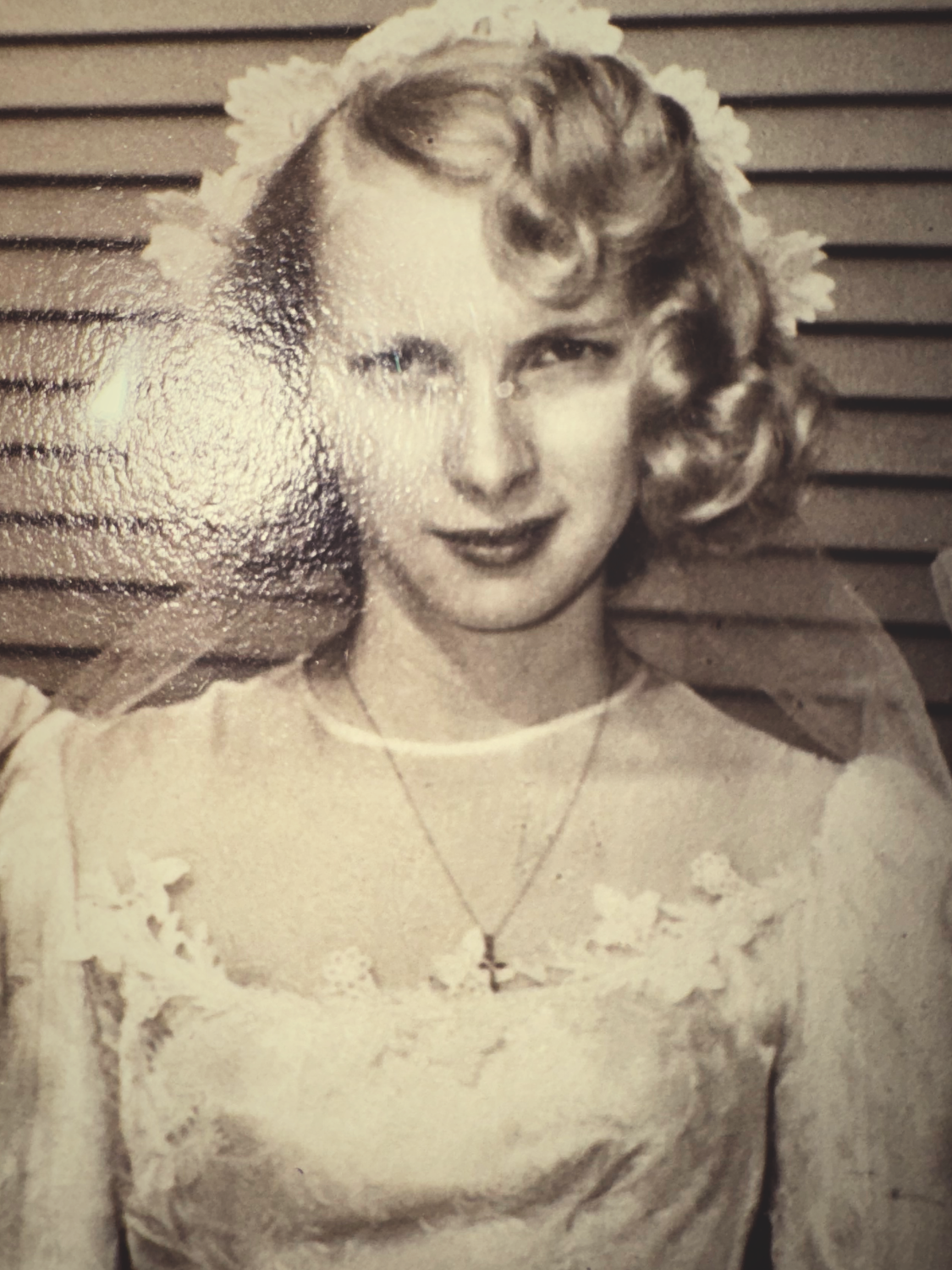
Before dementia softened some edges, my gram was fiercely strong and independent. She baked (my fave: cream puffs). She cooked full meals from scratch (Sunday roasts before I ever had one in England). She worked as a librarian well into her 80s. She loved reading books and always had stacks... and she kept handwritten notes about what she read, her own analog Goodreads. She wrote letters every single day. Real letters, with stamps, to friends and family across the U.S. and even abroad. (If you’ve ever received a mailed letter from me, know it’s because of my gram.) 💌
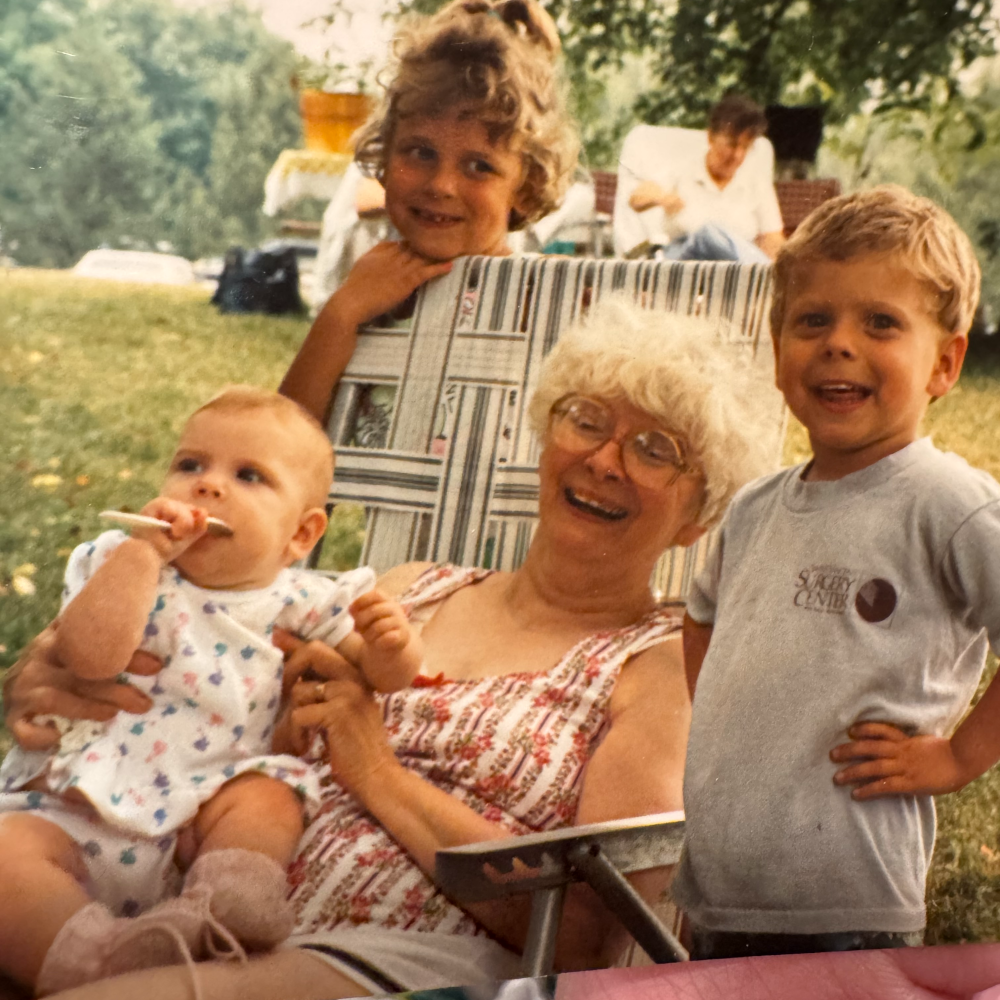
Early gram days
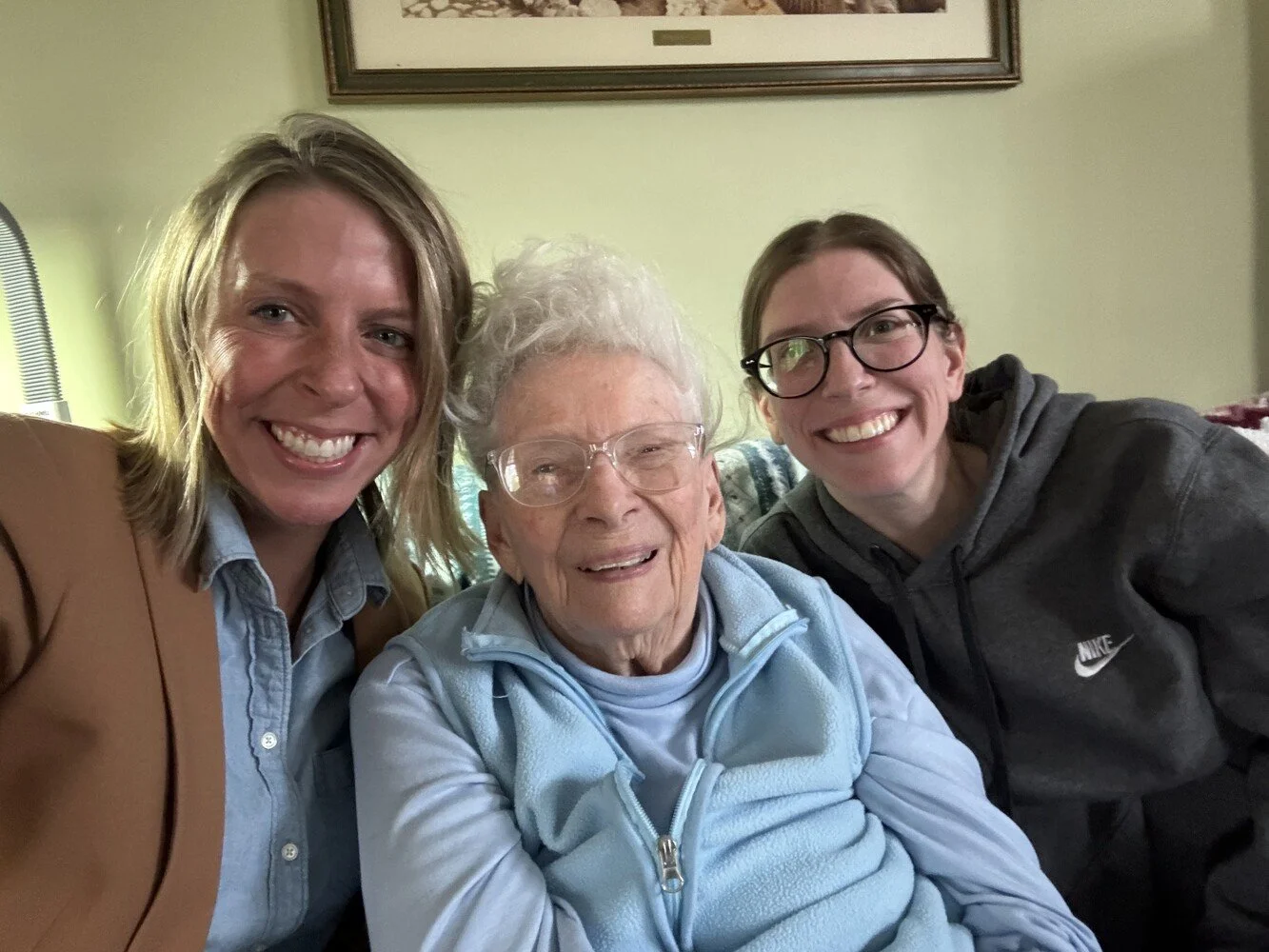
She always asked for my business cards, even when they were basically obsolete and I was the only one ordering them. 🫠 She knew about my various jobs, down to the HQ location of remote roles, my work trips, and my overall career. Working from home fascinated her, as it would when you're born in 1930. But, she also just got it. She was my biggest fan in the purest sense of the phrase.
Throughout my life, she was always present. As a kid, she brushed my hair and told me there was gold woven into it. My siblings and I spent summer weeks at her house, full of crafts, parks, trips to Two Mile Run (which, as a child, I was relieved to learn was not an actual two-mile run), and as I got older, shopping trips to the outlet mall. She loved a hot cup of tea (tea kettle, no microwave, only Red Rose Tea), had a quick witted, sharp sense of humor, and a deeply practical, no-nonsense approach to life... the kind that made you feel grounded just being around her.
The Lessons That Stay
I haven't put much thought into the lessons yet, but rattling these off the top of my head, they'd look like this (and of course they feel like bigger lessons as the years go on):
Family is everything
Stay connected, even when it takes effort
Be part of your community and give back
Keep reading and learning
Take the trip when you can
And never forget to be grateful
I have letters from gram and journals of my own with highlights from our phone calls and visits from over the years. As she once wrote to me, “Thank God for the gifts He gave you, like common sense. That’s a hard one.” 😆
The last time I said goodbye to her, she couldn’t speak anymore. But she was alert, her bright blue eyes were fixed on me as I thanked her for being the best grandma, told her how lucky I was, and expressed how much I loved her. My sibling Abby pointed out that her face was moving...like she was responding, recognizing, acknowledging the life and relationship we shared. I drove home to Ohio that night. She passed less than 48 hours later.
Carrying It Forward
So, on the evening of 1/1/26, as Greg wraps up a third batch of my gram’s cream puffs in the last 24 hours (we are perfecting them), I’m finishing up this unexpected healthcare love letter to my grandma... and an abbreviated reflection on 2025:
It was a year of real contrast. A year with incredible highlights and real challenges, professionally and personally. I don’t usually get into horoscopes or “Year of the ___” themes, but learning that 2025 was the Year of the Snake, a year of shedding, clearing, and hard truths, had me re-reading over and over. It fits more than I expected.
And even with the very hard stuff, there were MANY moments of brightness and joy that I’m always, ALWAYS appreciative of. Communities like Swaay.Health Marketing Community and Bluebird Leaders top the list, from sharing the stage with brilliant humans, to being humbled to co-win Community Member of the Year with Carol Flagg, to feeling genuinely lifted UP during moments when I needed it most. ✨
Now, as we step into 2026, the Year of the Horse, I’m choosing to call it the Year of the Unicorn. 🦄 Here's to movement, momentum, and possibility, with a touch of flair. 💖
SOOOO, as I like to say, "long story long." If you're still with me, thanks, lol. 🥲😆🤍 I sure needed to just type/write freely! ✍🏼 And if there’s one thing I’m carrying forward into 2026, it’s this: progress matters... but presence does too. And the time I spent with my gram in her final days, made possible by support and flexibility and kindness, is the greatest achievement I could ever look back on in 2025.